Showing posts with label Art on Products. Show all posts

Sunday, January 26, 2014

Selling in Your Sleep - Artist Nic Squirrell

Valentine's Days is coming up and I have read now so much about what to like or not like about this particular occasion that I can't help it but smile.

But In the world of commercial art this is another opportunity to either sell or license art. I am trying to do both, license and sell through wholesale manufacturers and through POD sites. So I have create some designs for tablets and smartphone cases which could make cool gifts. They are available for purchasing at Keka.com.

LoveLove Collection
Speaking of POD sites, today I've invited artist Nic Squirrell to share with us her story and how she has been selling her art through online venues.

© Nic Squirrell
Nic lives in a village in Kent, England, "with The Chef, our daughter, and three cats (somewhat pesky studio assistants)" she says. Her family moved around a lot, and she grew up in Japan and got to go to lots of interesting places. She studied Creative Visual Art & 3D Design at the University of Greenwich and after graduating sold her paintings in local galleries, restaurants and cafés. She tells us: "One day I saw a magazine article about digital art and it was a revelation. I got a small graphics tablet, taught myself to use Painter, and started my blog. Since then I have been selling most of my art on POD sites."

She then continues, "I love to paint quiet landscapes, slightly wonky towns and cities, and quirky animal characters which surprise me by falling off the end of my pen. Birds often sneak into my pictures."

© Nic Squirrell
Her techniques? Most of her work now is digital. She starts with sketches, photographs them, and uses iDraw (vector) or Procreate (raster) apps to work them into a digital image. "Using the iPad is great as I can work anywhere. I often use scanned hand painted textures to finish off in Painter or Photoshop," she adds. "I use Painter for my more complex landscape paintings. You can read about my process here. My favourite 'real' art material is watercolour. I love the unexpected runs and bleeds, the clear colours, and the lack of undo."

© Nic Squirrell
Nic also says, "My head is full of ideas, places and creatures waiting to get out. Everything about it is exciting, and I love seeing my art on products for sale."

Her main sources of inspiration are colour, nature, and life. In recent times she has been working on an exciting project, in fact she just finished an Advent calendar and started an ABC series. "So far I have finished A...", she says.

Nic is an artist who uses multiple social media platforms and understands how to use marketing to promote her works and sales. She simply but wisely says: "My blog publishes to my website, my Facebook page and Twitter. I blog sketches, works in progress, and finished pieces. I use LinkedIn and Pinterest. Marketing is really just telling people about what you are doing. Nobody buys art they haven't seen, so the more people who see it the better."

© Nic Squirrell
She is pretty new to licensing and hadn't even heard of it until last summer. "I have just finished the first part of Lilla Rogers' MATS course and learned a huge amount from it, as well as making lots of new talented artist friends who are kind enough to share their knowledge and experience. I'm looking forward to the second part in a few weeks."

Here are some tips for other artists: "When selling on POD sites, use more than one. Some images sell really well on Site A, but not on Site B, and it is hard to predict. It takes a long time to build up your sales and you have to do your own marketing - don't rely on buyers stumbling upon your work among all the other artists out there. But it is fun to wake up in the morning and see what you have sold in your sleep."

Nic's future aspirations and goals are to build up her portfolio and really get going with licensing her work this year.

© Nic Squirrell

Find out more about Nic Squirrell here:

Twitter@nicsquirrell

Thursday, June 6, 2013

Our Journey In Art Licensing So Far


© Alessandra Colombo

As mentioned in our first article about Surtex 2013, this particular trade show was a great experience that has given us more direct insights into the art licensing world. So we want to share here some thoughts that might be helpful to newbies that are thinking about joining the ranks.

Art licensing to us isn't just something you learn how to do with time and experience, but rather a constant evolving of creativity and relationships. It can shape and evolve in so many ways, as you progress in it. There is no set way into licensing as many veterans have already said. You can do it through trade shows, online contacts and social media, networking, by being a manufacturer yourself first and then switching sides, you can do it through an agency or solo, and so on.

This industry brings lots of joy to your life when you score a good design that ends up in a profitable contract, as it gives you a rare yet odd sense of accomplishment when you see your art on a product. It's absolutely thrilling!

But it also puts an unkind pressure on your everyday life that builds up over the months, as you go through some wild-ride ups and downs. Sometimes it feels like you lost a major battle, although most of the times it feels like so much fun, too. It's crazy-competitive. It's also really exhausting. It's undoubtedly risky and requires some financial investment upfront. It takes years to build up a both portfolio of art AND contacts, even if you get licenses early on. There are no set rules, only the ones established by yourself and your clients in a confidential agreement, which are put in place to regulate the licensing deal. It's a business based on trust. The licensing community, inclusive of both artists and manufacturers, is one of the most friendly and inspiring bunch of good hearted people I have known in the design industry.

Art licensing should not be viewed as a race against other artists. Many have pioneered the field so well that they know how to keep their licensing deals going for many years and make a good living at it. We can all learn from them, but as they will tell you, they are not experts either.


In short, licensing is a very subjective, entrepreneurial adventure, whether you do it solo or with an agent. If you like to keep doing it despite the tough times, a few serious emotional melt-downs and many sizable mistakes, then you will feel you have reached the top of the world. It's only then that you realize, it's not the top...! It is challenging, unpredictable, and seemingly capricious.

From our point of view, the path into art licensing and the experience and opportunity of a trade show like Surtex can take hundreds of different routes. That is part of what makes this whole field so exciting and dynamic...and difficult to understand! If you like changes and a flexible lifestyle, art licensing is a perfect job for you! From what we've learned so far, though, here are a set of rough guidelines that we've tried to capture for ourselves and which we'll certainly continue to refine the more we learn about this field. We are no experts; remember, we are just learning through this multi-faceted journey and we speak out of our personal experience so far. I am sure we will refine our tales as we move on and get more and more familiar with it all.

The steps below are not in any particular sequence and although we tried to make it somewhat a flow, remember that it's a very fluid, dynamic flow.


Roughly, a Route into Art Licensing
  1. Do a preliminary research of this industry by reading basic art licensing books, trade magazines, forum threads and by walking a show or two. Define for yourself what art licensing literally means, what it is all about, and then honestly set a purpose for yourself: why are you doing art licensing? Hopefully money is not your answer because it might not work out, even if you work really hard.
  2. Build your own brand based on a true story that is representative of you and your core values. This might include your brand name and logo.
  3. Create beautiful artwork for commercial use, starting from the product and working backwards. Create your own unique look - don't copy or model off of others, be your own self. It will not only create goodwill within the artist community, it will be noticed by manufacturers and that will increase the reputation of your own brand. Commit yourself to creating quality work and high integrity. Have fun with it!
  4. With your unique and stunning art tell stories that can be commercially used. Product development is your password! You want to get really good at that - licensing is a land of opportunities and if your art is product-ready through developed product concepts the opportunities to score a contract are higher, providing that your art matches the company's needs and style, and your timing is right. So it takes years to accomplish, because you will need to build up your portfolio, fix it, tweak it and make it better and better and then do more of it!
  5. Design a suitable presentation for your art that also promotes your brand and tells your message. This might include your portfolio, website, blog, social media profiles and interactions, press releases, tear-sheets, trade shows, promotion pieces, etc. Maintain a consistent look while you tweak it over and over as you learn more about licensing.
  6. Professionally connect to art licensing groups, forums and trade publications; learn more about the many facets of the business and continue to expand your knowledge as you balance your creative work and your business efforts. It's best to not ask for proprietary information from your fellow artists or take some "elements that you like" from their work. Figure out your own interpretation and creative path and look out for free tips. They are published about everywhere, so read up on them. Not just once but many times. The same information will become more clear as you get more experience under your belt.
  7. Research out and decide what categories of products and manufacturers you want to license with; by matching your art to their product's styles you have better chances to get a license. We advise to not shoot broadly or just sign up with a rep without understanding what you're doing. By being professional in anything you do and by recognizing that you have to be in it for the long-term you will help your business through the tough times.
  8. Brand yourself and your business through effective but sensible marketing. Beware of spamming others and instead provide relevant and value-added contributions to forums. When you help others to grow, they will help you back. This implies that social media and forums is about participation, not just lurking. You have to get involved, and just reading threads doesn't count!
  9. Ask for legal advice or read up about legal matters, don't just enter a contract without understanding what you're signing. Make sure you know what you want out of an agreement. It's your art and you want to set the rules.
  10. Represented or not, make sure you understand what is being done with your art and licensing contracts. Ask questions, be pro-active and learn the business for yourself. You never know what will happen next. Be willing to experience anything and be ready for any and all future circumstances.
  11. If you decide to exhibit solo at a trade show like Surtex (there are other licensing shows to also consider), plan a low-cost design to keep down the overall expenses but keep a high quality presentation that reflects your story and style. Make as many pre-show appointments as you can, by emails or phone calls; if you can't confirm the clients before your show don't worry too much, they might stop by anyway or if they see art they can use for their products.
  12. While in the midst of the show, don't forget to smile and try to enjoy the experience and be present in the moment; you never know what the next encounter will bring or how significant it might become. A show is like the land of opportunities, you just need to look out for them and then ethically seize the best ones for you.
  13. After it's all over and you've finally torn down your booth, enjoy a great hard-won show!
  14. But don't stop now, immediately follow-up on any commitments or opportunities that presented themselves during the show. You want to build relationships and work with companies that like your art and that you like. It's better to have no contracts than bad contracts that tie up your art and time.
  15. Hopefully sign lots of good, profitable contracts! Again, makes sure you know what you're signing and if you don't, look for legal advice.
  16. And throughout the above steps, work really hard and don't stop! Keep your eye on the horizon and the long-term view of your goal.
  17. Remember that until you sign a contract and your design sells on products you won't get paid ...
  18. If a design fails to sell or it doesn't work out, find out what went wrong, review the situation, learn from it and try your best again.
  19. Creating a partnership with your clients makes this a fun and creative adventure.
  20. Relationships, relationships, relationships...
"Everything good that comes to you is a direct result of your taking responsibility mixed in with a healthy smattering of actually doing." by Alex Mather, Red Lemon Club

So here's to an even better year!

Thursday, February 14, 2013

Retro-Inspired Art - Artist Claudine Hellmuth


In my travels I sometime meet some interesting people and artists. They make beautiful art and products. Sara of Julian Quilts Plus is one of them, a very talented lady who I just met in Julian, California - an historical landmark where I stopped for lunch. She makes quilts in her shop and the one below for Valentine's day is a beauty. Her prices are very reasonable too - she asked me to please design more fabrics with red on beige or ivory backgrounds because she has a hard time to find them for her quilts, so I am posting this request for all textile designers and quilt manufacturers to take this great feedback into account for their next collections :). You can contact Sara directly at sarasquilting@gmail.com if you want one of her beautiful quilts!
Quilting Artist Sara
What makes people get inspired? What do they like? My new guest this week, Claudine Hellmuth, talks about retro-inspired art and licensing.

Artist Claudine Hellmuth
TMFMA: Please introduce yourself - Hi and thanks for having me here for an interview! I'm Claudine Hellmuth and I'm an artist and illustrator. I live in Washington, D.C. with my husband Paul and our dog Maggie and our cats Mabel and Brian.

TMFMA: What's exciting about your creative work? I love the challenge of solving creative and visual problems for my clients. Each new illustration has its own challenges and it's always exciting to think of solutions that fit with my clients needs and incorporate my own artistic style.

© Claudine Hellmuth
TMFMA: Who or what has inspired you in your art? I am always inspired by the retro campy magazine ads from the 1940s and 1950s. I love how over the top they are with women showing how excited they are by their new oven or dishwasher. I have an old Sears catalog from the 1940's that is endlessly inspiring. I also am inspired by folk art, too. The American Visionary Art Museum in Baltimore is my favorite museum!

TMFMA: What's your favorite medium or tool/s you create with? For illustration and licensing work I create with a hybrid of computer and by hand. I prefer to use Photoshop for illustration and licensing because that way I can respond quickly to art director's requests and almost always there are some changes needed so this way I can quickly adjust color, size etc.

© Claudine Hellmuth
TMFMA: How long have you been doing art licensing? I have been licensing my art for use on products since 1998. In the early days I was more in the home decor markets and now I am licensing to the craft and gift markets as my work has evolved to a more whimsical look. Licensing is a tricky business. As soon as I feel I am making good headway in it something falls through. I often feel like with licensing it's two steps forward and one step back. If you are interested in licensing your work, artist Tara Reed has some great information on her web site to get you started. 


© Claudine Hellmuth
One thing that is good to know about licensing is that it isn't as much money as it appears to be! It looks like an artist who has her own stationery line would be raking in the $$ but when you look at the numbers, she's probably only making $0.15 per notepad sold. You've got to sell a lot of notepads to pay the rent!! Still, there are some artists that make 6 figure incomes on licensing so there is the possibility to really make a good income if you hit the right markets.

TMFMA: What brought you to exhibit for the first time and how many shows have you exhibited in? I have only shown at Surtex a couple of times and both times were with an agent or rep and were quite a few years ago. It is enormously expensive to do it on one's own but many artists go for it and have great shows! I began attending CHA in 2003 to promote the release of my first book. Since then I have attended every year but under the umbrella of a manufacturer or publisher. 


© Claudine Hellmuth
I have never had my own booth but my products have been in manufacturer's booths. This year I am having a designer table which is a table display in a special section on the booth floor. We'll see how that goes!!

TMFMA: Do you work with an agent or do you represent yourself? I work with an agent for my illustration work; her name is Jennifer Vaughn and she is fabulous. We have been together for nearly 7 years!

TMFMA: Please give us your analysis of the market based on your own experience and contacts. Illustration continues to be slow. So many companies that used to hire illustrators are now relying on stock. Don't get me wrong, there are plenty of illustrators out there getting work, but the jobs are not as plentiful as they once were.

© Claudine Hellmuth
TMFMA: In your view, what was of major interest to manufacturers this year? What do you think the main trends are for 2012-2013? I think the collage mixed media art style is still very strong. Manufacturers also love quotes and text with artwork and that trend seems to be holding steady as well.

TMFMA: What advice would you give other artists that are considering the illustration or/and art licensing fields and that maybe want to exhibit in a show (like Surtex for example)? I would advise them to walk the show before exhibiting. Follow the artist Tara Reed, she has tons of information on her web site about licensing and also hosts great phone calls with experts that you can listen to.


View more of Claudine's work and follow her at:


Wednesday, January 16, 2013

Atlanta Gift & Home Furnishings Market 2013 - Show Recap and News

I am sitting on the floor at home pawing through a stack of impeccably designed trade magazines, directories and promotional pieces while pondering about all that happened at the fabulous Atlanta Gift and Home Furnishings show this past weekend. It's been a wild but amazing 3-day ride!

Amongst many firm shakes of hands, courteous presentations and vivacious chats, I kept hearing the word "trend." It's becoming trendy to talk about trends.

Courtesy of Design Design Inc. - From Their Catalog: Trends
By whatever mechanisms, trends are present. Artists set trends by capturing images and patterns artistically. Manufacturers do, too, through product choices, materials and quality of execution. Retailers try to capture trends through the products they offer to consumers and how they display and market them. And, finally, it is the consumers cumulative actions that actually set them.

I think it's best to look at this whole notion of trends in a relative way - your way. I try to discern trends for inspiration and for getting a pulse about other views and cultures; I don't necessarily have to follow them. I follow what I like and believe in. For example, there is an outdoor living trend that showed up everywhere at the Atlanta show, even on the huge electronic billboard in the lobby. I love this trend and started embracing it last year in my collections, because the outdoors has always been a big part of my life.

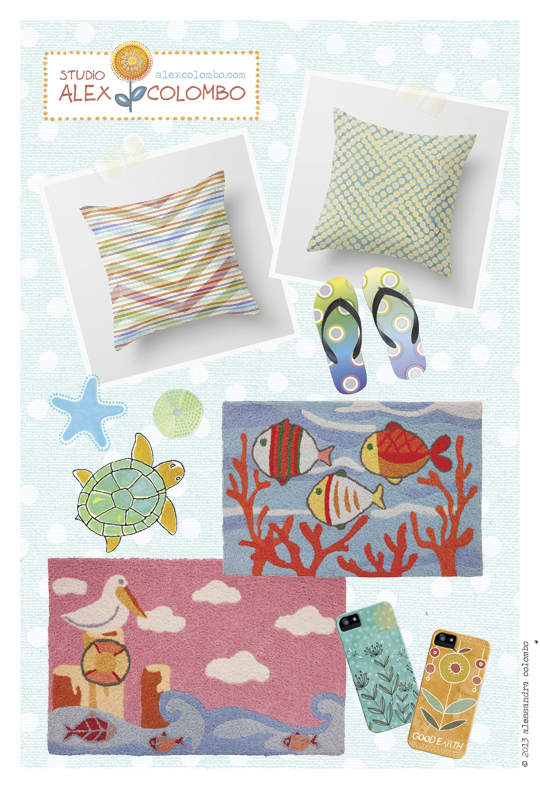
While outdoor living is an example of a trend that is developing more momentum, an example of a trend that is more of a classic style is coastal and seaside. Recently, I met a pelican at a local wharf. He ended up in one of my seaside collections and has now become a half celeb through a JellyBean rug! (By the way, the pelican's name is Gabriel...) Is he part of a trend? I don't think so. But he's a nice dude and it so happens that he does fit into the coastal trend.

Courtesy of Design Design Inc. - From Their Catalog: Handmade
Set or follow trends that are suitable to your creative process, similar to how Design Design Inc. created these cool inspirational boards for their catalogs. We had the great pleasure of meeting their Art Directors and Chief Marketing Officer at the show and had one of the best conversations of the whole weekend. Such nice people and what quality work! They get it. By the way, they also provide a very detailed artist submission guideline. How much better could it get?!

There are many other companies that offer such collaborative offers. So yes, trends are all of us as a whole, our families and pets, friends, sharing circles, close co-workers, and our houses and what's in them. Classic, vintage, retro, modern, transitional or traditional. As I see it, the challenge of a licensing artist and the real value of a show like Atlanta is to help you better see where all those collective interests and ideas are headed, and thus how to adapt and interpret them in your art to improve your manufacturing partner's chances of success.


© Courtesy of Demdaco
All together the world of art, design and products is really one big cohesive whole that is made up of multiple people and views. I think this is the key concept I was reminded of at the Atlanta show. It was fun. It was thrilling. It was friendly and positive. It was so productive for us as it was for the majority of the people we spoke to. It included collaborative insights and a source of unexpected friendships. We'll definitely be going again next year!

Here are some more cool photos we were able to take with the blessing of the exhibiting manufacturers. We didn't have time to see every single showroom or meet each of the exhibitors and artists at the show, but we picked these to talk about because we thought they would be of broad interest to this audience, not because they are the most important or the best of the show.

© Courtesy of Demdaco
The Atlanta Gift Show is one of high-quality merchandise. The displays were bright, cheerful and tastefully displayed throughout the market floors. We spotted several that were retro/vintage inspired, with the red and blue popular color combos as a fun alternative to more traditional holiday colors. You can see them in the photos from the Demdaco and Enesco showrooms.

As mentioned above, trends and themes such as gardens, eco-green, indoor-outdoor living were very prominent throughout the show.

© Courtesy of Enesco
There is continued growing interest in this natural, nomadic, primitive, explorative direction as represented through visuals, words, scents, colors and other senses, talked about at the 2012 Surtex show. It's a mix of concepts. The themes are pretty much the same, but reinterpreted by artists in partnership with their manufacturers, retailers and their respective niche of consumers.

Walking through the floors was exhausting but most of the displays were very inviting and always colorful, some peaceful, with classic outdoor elements dressed up with whimsical images, shapes and/or inspirational phrases meant to uplift the spirits. We saw many little birds, owls, cardinals, butterflies, frogs, bugs, florals of all sorts and hues. Mixed media designs with enchanting themes, graphics, geometrics, natural materials, and vintage backgrounds were also abundant. What a mix!


© Courtesy of Demdaco
Two terms seem to be growing in interest: "boho" and "gypsy." We also noticed many industrial elements, like heavy metal objects mixed in with vintage/farm elements and inspirational concepts and words. Word art and fancy calligraphy are still big, either hand painted, hand drawn or typed, with chalk, pen, brush or simply pencil. Jute, burlap, cord, felt, and other craft materials are also coming to the market in a strong way. The home design and home products showrooms were full of them, from lampshades to chairs, accessories and wall art - even Christmas ornaments!

Dimensional art was also popular with colorful cards, gifts and accessories. Many Christmas fantasy themes were presented with sleek polar bears and regal foxes, or the more everyday themes such as farm life with roosters and pigs, or ponds with hoppy frogs and dragonflies; cute raccoons and hedgehogs are joining the already crowded parade in their debut to the consumer world. And of course family dogs and cats are still pretty much everywhere along with horses and deer. If there isn't a trend in there you can relate to, then you should take up knitting! Which, by the way, is also a trend!

© Courtesy of Vietri
As the Atlanta Mart logo says, this show is for international wholesalers. Many of them do not license art. They have in-house design teams or occasionally hire freelancers. Some of them are distributors only so they don't license directly but work with manufacturers and their exclusive artists. Some of them are a company umbrella representing artisans from other countries. People attending the show come from all over the world, including Europe, Asia, and South America, although most are from the U.S. As a result, while you do see a global market it is still mostly domestically-oriented. We got to chat a bit with the National Sales manager for Vietri - their showroom was breathtaking. The collection shown here is by Italian artist Giovanni De Simone but they include over 40 different Italian manufacturers in their product offerings. It was so inspirational to look at!

What else? We met with many manufacturers and introduced The Moon from My Attic to them, although were pleasantly surprised to find out that many were already regular readers. There is an increasing excitement about this collaboration between artists and companies, about what we are doing to help bridge the two ends of the product development process and create more collaborative partnerships. We have discovered that manufacturers are noticing artists through this blog and vice versa. We are happy about this new evolution. In upcoming months we will surprise you with more special referrals, editorials and promotions!

We got to meet some great artists who we'd previously only met via email or Facebook. What a treat! We wished we had more time to see everyone who expressed interest in connecting up at the market; more trade shows are on the horizon, with Surtex 2013 being our next stop. We'll be exhibiting there at Booth 446! So we are sure we'll connect with many of you who also have a booth or just want to walk the show.

Magnet Works Flag - © Alex Colombo
In summary, the whole show was an amusing and very productive one for us, in addition to getting to know the market a bit better and meeting very nice and friendly people. Etiquette is an important part of how to navigate such a show, with respect to many who are working really hard at this business. All people we talked to had a positive and encouraging result from the show. We also had a chance to see some of my art on products, which was really fun. We hope more will come!

As a final note on the Atlanta show, I think it's a fantastic experience for licensing artists for doing market research; it gives you greater insight into art, products and how the product development-wholesale-retail-consumer business operates.

I am sure other show participants can add to my observations so feel free to comment on this article. I invite you to also read other licensing and trade blogs about the show so as to get multiple views. For me, seeing the whole chain of production at work re-enforced my main purpose: partnering to make the world a better place through art!

___________________________________